
Emergency Air Duct Cleaning Near Me: What Oklahoma City Homeowners Should Do First
After a tornado passes through the metro or a sewer line backs up into the crawlspace, the instinct is to call a duct cleaning company immediately. That’s usually the wrong first move. Three things need to happen before any contractor arrives: shut the HVAC system down, photograph everything, and notify your insurer. The order matters, and skipping a step can spread contamination further or complicate the claim. Here’s what to do in the first hour, and what to tell us when you call (855) 360-8688.
What actually counts as an emergency duct cleaning in Oklahoma City?
A real duct emergency is any event that pushes a hazardous contaminant into the duct system: smoke and soot from a house fire, fire-suppression residue, sewage backup, tornado or wind-driven storm debris intrusion, or a renovation that filled the system with drywall dust. Those situations call for isolation and documentation before cleaning.
Most other complaints don’t belong in that category. Musty odors, visible dust, allergy flare-ups, or a system that hasn’t been cleaned in years feel urgent to the person living with them, but they can safely wait for a scheduled appointment. Oklahoma City homes sit in a storm-prone corridor with heavy spring winds, which means debris intrusion is the most common genuine emergency we encounter. Sewage backup is rarer but more serious because the contaminant is biological. Smoke is the most time-sensitive because soot settles into surfaces and odor compounds stick to duct walls fast.
If you’re unsure which category your situation belongs to, describe what happened and what you see. We’ll tell you honestly whether it needs a fast response or a normal booking, and we answer 24/7.
What should you do before an emergency duct cleaning company arrives?
Complete these steps in order. They protect you, your home, and your insurance claim.
- Shut the HVAC system off at the thermostat and the air handler breaker. Running the fan pulls contaminated air from the affected space and pushes it through every supply run in the house. This is the single most important step, and it takes ten seconds.
- Close the supply registers in affected rooms so debris and odor don’t migrate into clean spaces.
- Photograph and video everything before you touch more than the thermostat. Capture the source (burned wall, backed-up drain, debris pile), the visible dust or soot, and each register in the affected zone. Insurers want evidence of the loss as it happened, not after cleanup.
- Call your insurer and open a claim before the contractor arrives. Most policies require prompt notice. Get a claim number and ask whether the adjuster needs to inspect before any work begins. Sometimes they do. Knowing that before the crew shows up saves a fight later.
- Keep the receipts and the timeline. Note the date and time of the event and when you shut the system down.
Don’t run a shop vac or a box fan in the affected area as a substitute for professional equipment. Both stir settled contaminants back into the air.
How do you isolate an HVAC system after smoke, sewage, or storm debris gets in?
Isolation means stopping air movement between the contaminated zone and the rest of the house, and keeping the ducts themselves from carrying contaminants to clean rooms. The safe homeowner steps are limited: shut the system down, close registers, and stay out of the affected space. The rest is contractor work.
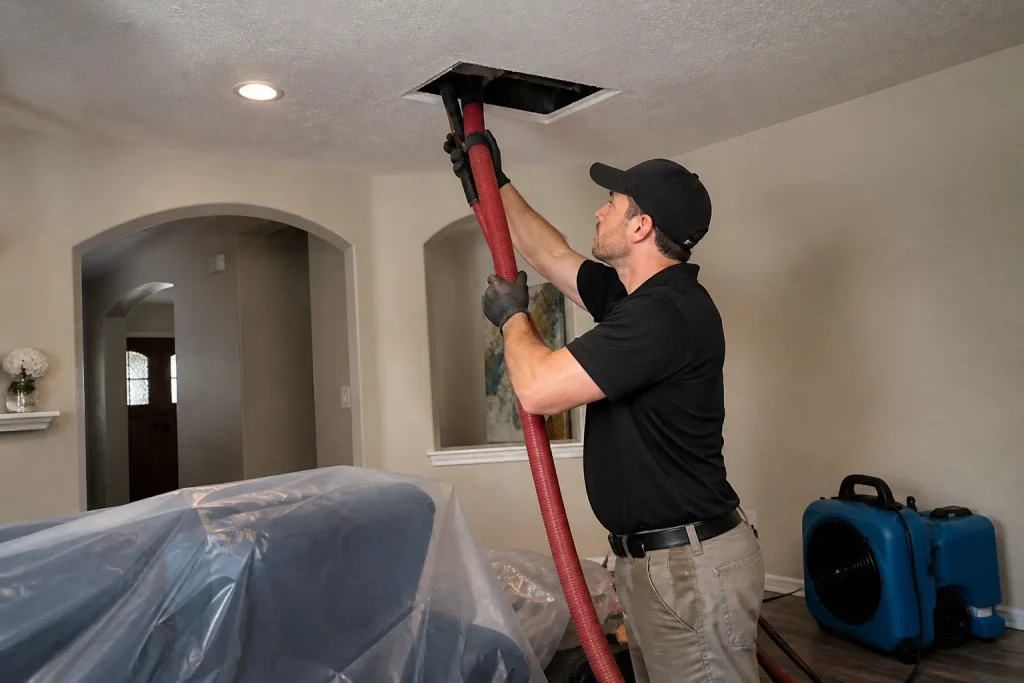
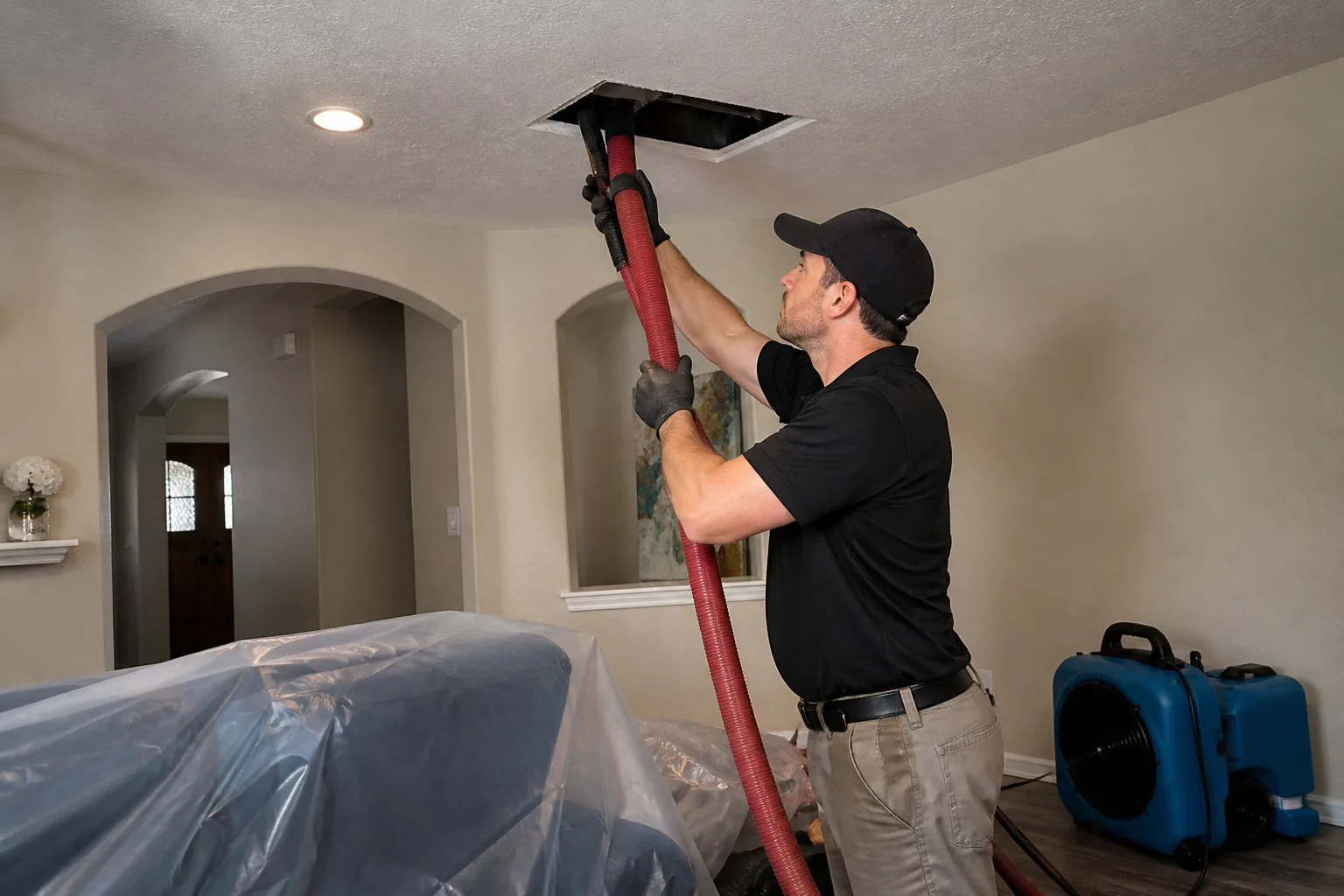
Professionally, isolation involves negative-air containment in the affected area and HEPA filtration on the vacuum side, so the contaminant is captured rather than pushed around. The reason we stock and service Abatement Technologies equipment is exactly this scenario: their negative-air and HEPA units are built for restoration work where containment is the whole job. A consumer-grade shop vac cannot do this. Neither can a compressed-air wand, which just aerosolizes the problem.
For a smoke event, the goal is capturing soot and odor compounds before they migrate. For sewage, the goal is biological containment. For tornado debris, it’s removing intrusion material and confirming the duct system is still sealed. Each of those requires a different containment setup. Call (855) 360-8688 with the contaminant type before anyone arrives. We dispatch Sunday through Friday, 7am to 7pm, and we’d rather show up with the right rig than improvise.
What should you tell the duct cleaning company on the phone?
Give them four facts, in this order:
- The contaminant type. “Smoke from a kitchen fire,” “sewage backup,” or “tornado debris” each requires different containment equipment and, in some cases, different crew preparation.
- The time it happened and whether you’ve run the system since. That tells them how far contamination has likely spread.
- The square footage and rough layout. One-story or two, basement or crawlspace, and whether the air handler is in the attic.
- The claim status. Open, adjuster-inspected, or not yet started. It affects sequencing.
Be ready for questions back. A well-run company will ask what you’ve already done (did you shut the system down?), whether the site has been cleared as safe, and whether any mold or water damage is involved. If the company quotes a price on the phone without knowing any of this, that’s a good sign to call someone else. Pricing for this kind of work is set per job by the written estimate after the scope is clear.
Use Shoreline Duct Cleaning as your benchmark for how the conversation should go. Detailed questions, specific equipment named, honest limits on what we can and can’t do.
Why is tornado season a unique kind of duct emergency in Oklahoma City?
Because the damage often lands on the duct system rather than the house. High-wind events push debris, insulation particles, and outside air through compromised attic ducts and return plenums. A house can show no obvious roof damage but still have a duct system full of grit and a substantially leakier envelope than it had before the storm.
That changes how the job is handled. A standard cleaning on a stable system is a straight mechanical job: rotary brush through the runs, HEPA vacuum on the returns, done. A storm-intrusion job starts with inspection: which runs are disconnected, which plenums are pulling attic air, and how much intrusion material actually got in. Sometimes the finding is a duct that should be repaired before it’s cleaned. That’s why we offer Air Duct Repair as a standalone service. Cleaning a leaking duct system is temporary work; sealing it is the fix, and we’d rather close the gap in one visit than tell you to book a second contractor.
Oklahoma City’s spring pattern of dry, wind-driven dust followed by tornado events means the debris is often a mix of soil, fiberglass insulation, and roof material. Standard rotary systems with HEPA vacuum, like the Rotobrush setup we run, handle that material well when the containment is right.
When to call a pro, and how does a scheduled air duct cleaning differ?
Call a pro for a true emergency (fire, sewage, storm intrusion). For an overdue but non-emergency system, schedule a proper air duct cleaning and ask what equipment they’ll bring. In our experience, the equipment question separates specialists from generalists faster than any review does. Professional-grade equipment, residential pricing, is the standard to hold anyone to.
Two adjustments matter for Oklahoma City homeowners specifically. First, run a dryer vent inspection any time you’ve had a nearby fire event, because lint in a dryer duct is itself a fire-safety problem and the same wind event that pushed debris into the HVAC system can stall airflow in the dryer. Dryer vent cleaning is a genuinely fire-safety service, not an upsell. Second, if your home has an air purifier or humidifier tied to the air handler, ask whether the contractor is set up to service Honeywell or Aprilaire components. Cleaning a system that has filtration hardware means coordinating the two.
Our technicians have up to experience, and the short answer to “who should I call” is: someone who will tell you on the phone what equipment they’re bringing and why. If you’re in Oklahoma City and want a straight answer, call (855) 360-8688.
The Bottom Line
Emergency duct cleaning isn’t the first call you make. It’s the third. Shut the HVAC system down, photograph everything, and open the claim with your insurer. Then call a company that will ask the right questions and bring the right equipment.
If you’re in Oklahoma City and need help, Shoreline Duct Cleaning offers free estimates. Call (855) 360-8688. We answer 24/7. Fast dispatch from 7am to 7pm, Sunday through Friday.
Frequently Asked Questions
As soon as the fire department clears the site as safe and your insurer’s adjuster has inspected, if they require it. Soot and odor compounds settle into duct surfaces fast, so the sooner the system is isolated and professionally cleaned, the less secondary damage you’ll face. Call (855) 360-8688 for a free estimate.
No. Running the system pushes storm debris and insulation particles from the return side into every supply run in the house. Shut the system off and have the ducts inspected. It’s a small inconvenience that prevents a much bigger cleanup.
Sometimes. Coverage depends on the cause of loss and your policy’s terms. Fire and storm damage are typically covered; long-term neglect or pre-existing moisture issues usually aren’t. Photograph the damage before any cleanup and open the claim before work begins. Your insurer’s decision controls, not ours.
Ask what vacuum and containment systems they’ll bring. A response that names HEPA vacuum and negative-air equipment (Nikro, Abatement Technologies, or equivalent) is a good sign. A response that mentions a shop vac or compressed air is a red flag. Call (855) 360-8688 for a free estimate and a straight answer.
Written by the team at Shoreline Duct Cleaning.
Need Air Duct Cleaning Help?
Call Shoreline Duct Cleaning - licensed & insured, here with fast help in Oklahoma City.
(855) 360-8688